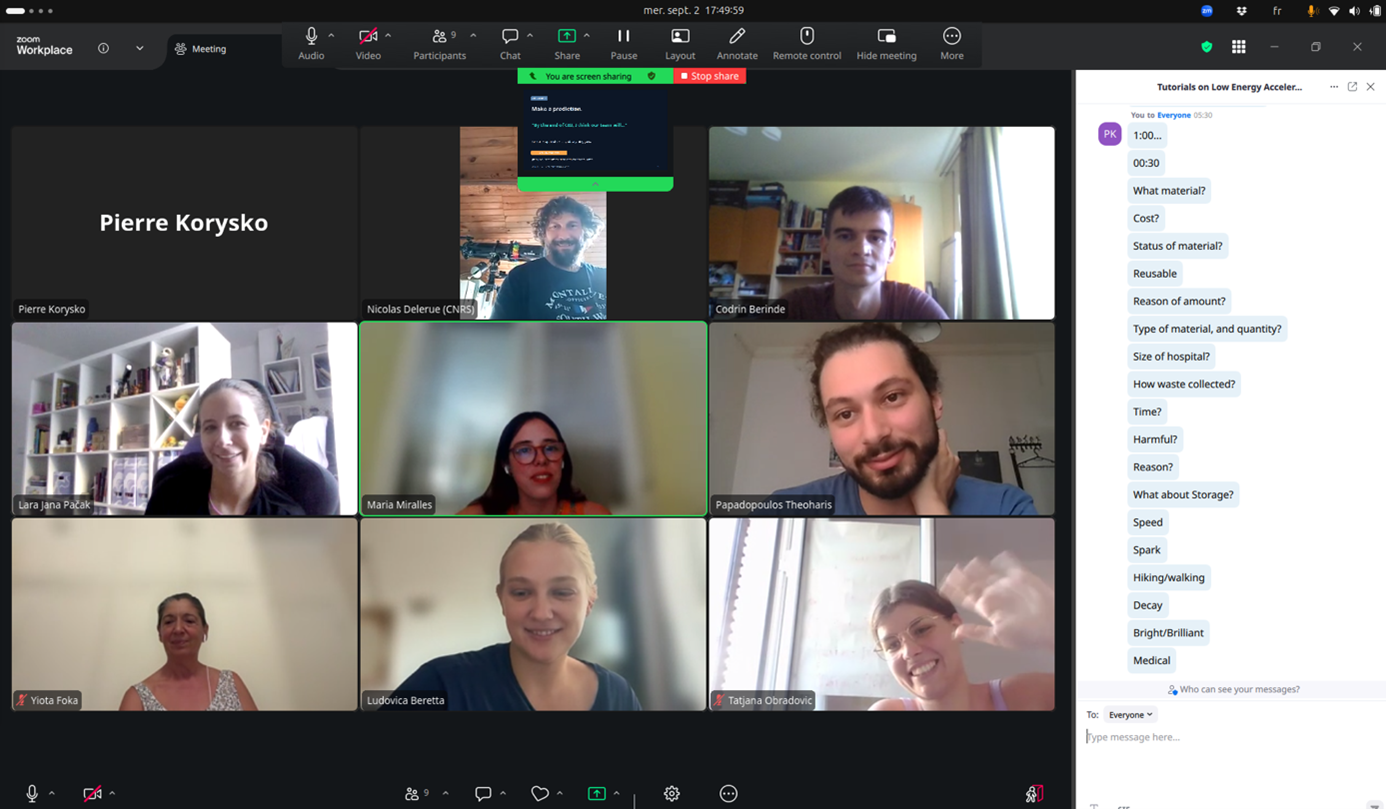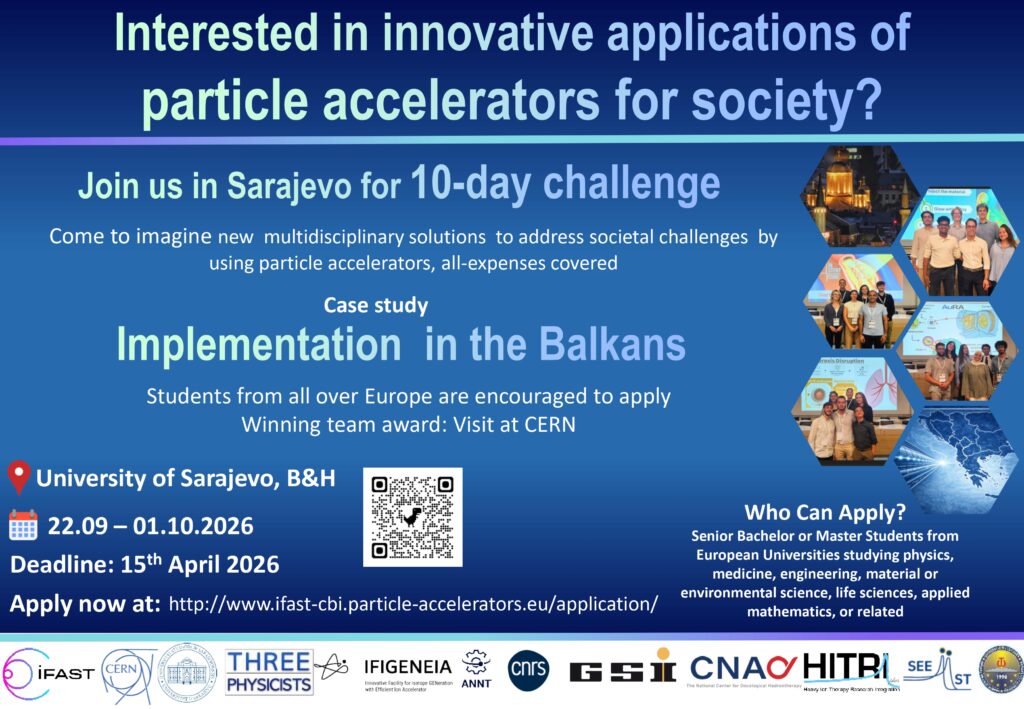
The Challenge Based Innovation 2026 programme began online on 1 September. Through introductory lectures, participating students are learning about particle accelerators and exploring how these technologies could benefit society.
From online learning to Sarajevo
The online programme will continue until 17 September. The students will then meet in Sarajevo for three days of lectures, discussions and collaborative activities at the University of Sarajevo.
This special edition of CBI focuses on innovative applications of low-energy accelerators, particularly those that could respond to the needs of regions such as the Balkans. The programme encourages students to develop their ideas from initial concepts towards potential practical applications.
Developing and presenting new ideas
After the three-day programme, the students will continue working on their projects from 24 to 30 September. On 1 October, each team will present its project to a jury. The programme will conclude with the final presentations and an award ceremony for the winning team.
The CBI forms part of the wider Particle Accelerators Applications for Society programme in Sarajevo. The programme connects students and experts interested in accelerator technologies and their practical applications.
As part of the IFIGENEIA project, these activities support collaboration, knowledge exchange and the exploration of practical applications of accelerator technologies.
We invited a lecturer and organiser and a participating student to share their perspectives on the CBI2026 programme.
The Challenge Based Innovation CBI2026 special edition focusing on Particle Accelerators’ Applications for Society (https://indico.cern.ch/event/1661135/page/42417-challenge-based-innovation) started on 1st September 2026 with online sessions.
The selected students had already the opportunity to attend a detailed introduction to the CBI and its evolution as well as to spend time with the members of their teams during “ice-breaking” sessions. These introductory sessions are being followed by online lectures, until 17 September, related to physics principles of accelerators and their applications. Then, on 22 September, the 4 teams of 6 students each, will meet in-person in Sarajevo, hosted by UNSA, to focus on their project proposals on various applications of low-energy accelerators that could make an important impact for society.
The students expressed already their satisfaction with the lectures so far and their eagerness to meet in person and delve into the challenge as can be witnessed by one of the UNSA students.
The lectures and activities we have had so far, including getting to know the other team members, have been really well organised. Even though everything is taking place online, I feel that this barrier has somehow been overcome and that a really nice atmosphere has been created, which makes me even more excited to start the challenge itself.
The lectures and speakers have been phenomenal, and I especially appreciate the opportunity to learn about accelerator physics from different perspectives, as the speakers come from diverse backgrounds. It is truly an honour to have the opportunity to learn from them, and it is clear how much time, effort, and thought the organisers have put into the entire program.
The IFIGENEIA project actively supports this initiative, that takes place in BiH, under its mentoring scheme, financially supporting several students from its partner institutes but also with expert lecturers as well as IFIGENEIA members being part of the CBI organising team (https://indico.cern.ch/event/1661135/page/42209-organization).
IFIGENEIA contributes to the award for the winning team, namely a trip at CERN that will give to the students a real-life experience of accelerators and their applications.