
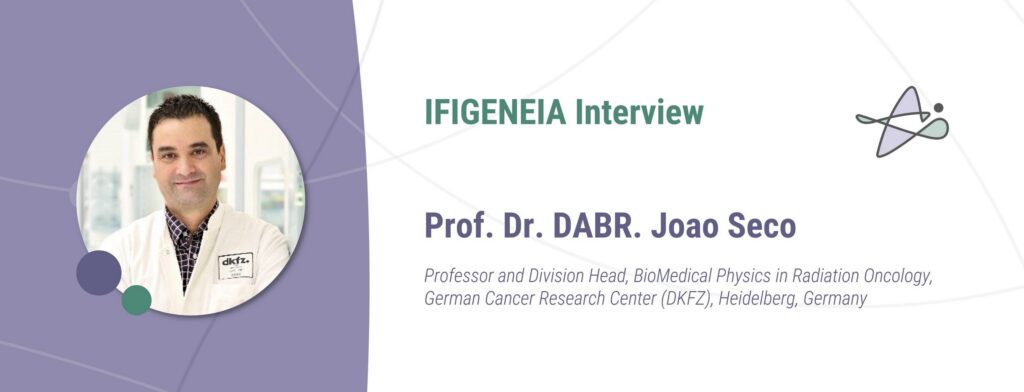
In November 2025, Prof. Dr. DABR. Joao Seco held several lectures and presentations in Slovenia about cancer treatments from different perspectives.
In the scope of his visit, he also shared his insights on how cancer research has developed in the past years and decades, about the different approaches in Europe and the USA, and how the IFIGENEIA project supports cancer research and therapies.
What was your motivation to dedicate your life and career to the cancer research?
From a young age, I was driven by a curiosity about how the world works and a deep desire to become a scientist. This passion led me to study physics, a field where my interests in both physics and mathematics naturally converged. During my undergraduate studies, I had the opportunity to explore a variety of research areas, including particle physics and superconductivity. While each area was intellectually stimulating, I found myself most inspired by medical physics, the powerful intersection between physics and patient care.
Seeing abstract physical principles translate into real clinical applications showed me how science can directly improve human health. That experience sparked my commitment to apply scientific discovery in ways that meaningfully impact patients’ lives. This motivation ultimately shaped my decision to pursue a career dedicated to advancing medical science.
Cancer treatment is changing. As recent advancements in radiation oncology show, FLASH-RT, SFRT and TRNT promise enhanced efficacy, safety and personalisation. What are the main differences between current cancer research and therapies compared to those that were available when you first began with your career as a young PhD graduate?
When I began my PhD, radiation therapy was undergoing a major transformation with the development and early clinical implementation of intensity-modulated radiotherapy (IMRT). At that time, only a handful of hospitals around the world had the capability to deliver IMRT treatments. My doctoral research focused on IMRT at one of these pioneering centers, and within five to ten years of completing my PhD, this technique had become widely adopted, evolving into the standard of care in radiotherapy worldwide.
In the past decade, another revolution has emerged with the discovery of immune checkpoint inhibitors (such as anti-PD-1, anti-PD-L1, and CTLA-4 antibodies). Immunotherapy has reshaped the landscape of cancer treatment and is increasingly being combined with established modalities, including radiotherapy. The integration of immunotherapy and radiation therapy holds tremendous promise, with the potential to further transform cancer care and significantly improve patient outcomes.
What is the latest main breakthrough in cancer therapy, and will it shape the future of research and patient treatment?
The single most important breakthrough in cancer treatment over the past 10 to 15 years has been the advent of immunotherapy, particularly through the use of immune checkpoint inhibitors such as anti-PD-1, anti-PD-L1, and CTLA-4 antibodies. Immunotherapy has opened entirely new possibilities for treating even the most advanced and previously untreatable cancers. By harnessing the patient’s own immune system to recognise and attack tumour cells, this approach has fundamentally changed our understanding of cancer biology and treatment potential. The integration of immunotherapy with radiotherapy and other modalities continues to push the boundaries of what can be achieved in cancer care, offering hope for durable responses and long-term remission in diseases once considered incurable.
What is needed to achieve the next breakthrough in cancer treatment?
This is a very complex question to answer, but I will do my best. Achieving the next major breakthrough in cancer research will require a combination of several key factors. First, we need a strong foundation of highly trained and skilled scientists. Second, access to state-of-the-art research facilities and technologies is essential to enable cutting-edge experimentation and discovery. Third, a large cohort of motivated young researchers, at the master’s and PhD levels, must be actively engaged in research projects, bringing fresh perspectives and energy to the field. Finally, sustained and substantial funding is crucial to support scientists at all career stages, from early trainees to the most experienced investigators, ensuring that innovative ideas can be developed and translated into real clinical progress.
Project IFIGENEIA connects linear accelerators with cancer treatment. In general perception, we usually consider accelerators as large and complex structures like the one in CERN. What are linear accelerators, and how can they help us in cancer therapy?
A linear accelerator (often called a linac) is a type of machine that accelerates charged particles, such as electrons or protons, along a straight path using electromagnetic fields. In the context of cancer therapy, a medical linear accelerator (LINAC) is one of the most important and widely used tools in modern radiation oncology. Within the scope of IFIGENEIA, linacs can play a critical role in the production of new radioisotopes for targeted radionuclide therapy (TRNT). Currently, TRNT faces a significant shortage of radioisotopes, limiting treatment options for many patients with advanced cancers. By enabling the production of these essential isotopes, linacs have the potential to expand the availability and effectiveness of TRNT, ultimately improving outcomes for patients who currently have few therapeutic alternatives.
With academia and working experience from the UK, USA and Germany, what are the main differences between the UK, USA and Germany for research?
In Europe, the majority of cancer research is conducted in dedicated research institutes focused on developing novel techniques, ideas, and methods to combat cancer. For example, in the UK, the largest cancer research institution is the Institute of Cancer Research (ICR), while in Germany, the German Cancer Research Center (DKFZ) accounts for approximately 80% of cancer-focused research. Because much of this work is performed in specialised research institutes, the majority of European cancer research emphasises basic science, with clinical translation occurring only at later stages.
In contrast, in the USA, cancer research is largely carried out within university hospitals, where clinical translation is the primary focus and basic research plays a comparatively smaller role. As a result, clinical research in the US is primarily driven by clinician-scientists, while in Europe, basic research is largely driven by career research scientists. This structural difference shapes the research priorities and timelines for translating discoveries into patient care in the two regions.
Can we expect the cancer will be one day just an ”ordinary” disease?
Cancer can broadly be divided into two main categories: early-stage and late-stage disease. Currently, early-stage cancer is often considered a relatively “ordinary” disease, in the sense that multiple treatment options are available that can achieve similar outcomes, namely, the potential cure of the cancer. The primary differences among these treatment approaches lie in the side effects and impact on the patient’s quality of life, rather than in overall survival.
In contrast, late-stage cancer is far more complex and challenging. It is rarely, if ever, considered “ordinary,” due to the high heterogeneity of the disease and the fact that very few treatments offer a true cure. Modern therapies for advanced cancer are primarily designed to prolong survival and improve quality of life, rather than to eradicate the disease completely. As a result, research in late-stage cancer focuses heavily on developing novel targeted therapies, FLASH, SFRT, immunotherapies, and combination treatments, with the goal of controlling disease progression, reducing symptoms, and extending meaningful survival for patients who currently have limited options.
If you are interested to learn more about cancer research, we invite you to watch the IFIGENEIA video lecture New technologies for cancer treatment: FLASH, SFRT and TRNT, where Prof. Dr. DABR. Joao SECO shared more insights into new promising cancer therapies with interesting facts.
Short CV
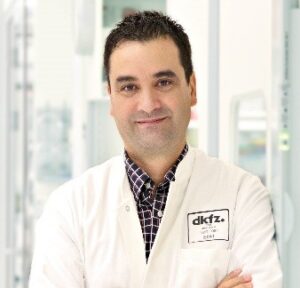
Prof. Dr. DABR. Joao Seco
Professor and Division Head, BioMedical Physics in Radiation Oncology, German Cancer Research Center (DKFZ), Heidelberg, Germany