
Within the framework of the IFIGENEIA project, an RFQ (Radio Frequency Quadrupole) demonstrator will be developed at the Aristotle University of Thessaloniki, in close collaboration with the Greek company YFOS. This demonstrator will serve as proof of principle for RFQ design and construction, directly supporting IFIGENEIA’s objective to strengthen European capacity in accelerator-based technologies and facilitate the transfer of research expertise into societal applications.
The IFIGENEIA RFQ demonstrator is inspired by the ELISA (Experimental LInac for Surface Analysis) accelerator, developed for the CERN Science Gateway. ELISA is a linear proton accelerator installed in the Science Gateway exhibition at CERN since October 2023, designed primarily for education and outreach. Through close collaboration with CERN experts, AUTH researchers and engineers will gain hands-on experience covering the full RFQ design, construction and operation phase.
This activity also builds on a long-standing collaboration between the Physics Department of Aristotle University of Thessaloniki and the CERN Accelerator and Beam Physics group. Under the scientific guidance of Dr Ioannis Papaphilippou, Group Leader of CERN/ABP and Visiting Scientist at AUTH, this collaboration has supported joint research, training, and education in accelerator physics over several years.
A central pillar of IFIGENEIA is the active involvement of industry in advanced accelerator development. In this context, the construction of the RFQ demonstrator will be carried out by the Greek company YFOS, working closely with CERN and AUTH. This collaboration ensures that accelerator know-how is transferred beyond academia and embedded within national industry, strengthening sustainable technological capabilities in Greece. The successful demonstration of this RFQ linac represents a critical milestone within IFIGENEIA. It will establish the technical readiness required to design and construct a more demanding RFQ-based LINAC dedicated to radioisotope production for medical applications. This future facility represents the final scope of the IFIGENEIA pathway, addressing the growing demand in the Balkans and Europe in general, for reliable, reasonably priced and locally produced medical radioisotopes for diagnostics and therapy.
The ELISA-inspired RFQ will remain permanently at the University of Thessaloniki as a tangible outcome of IFIGENEIA. It will serve both as an irradiation facility for cultural heritage studies and as a hands-on training platform for students. Its educational and societal impact will ensure the transfer of knowledge and will pave the way towards a future medical radioisotope production facility.
Stay tuned for the next steps of IFIGENEIA, as knowledge transfer evolves into sustainable medical applications.
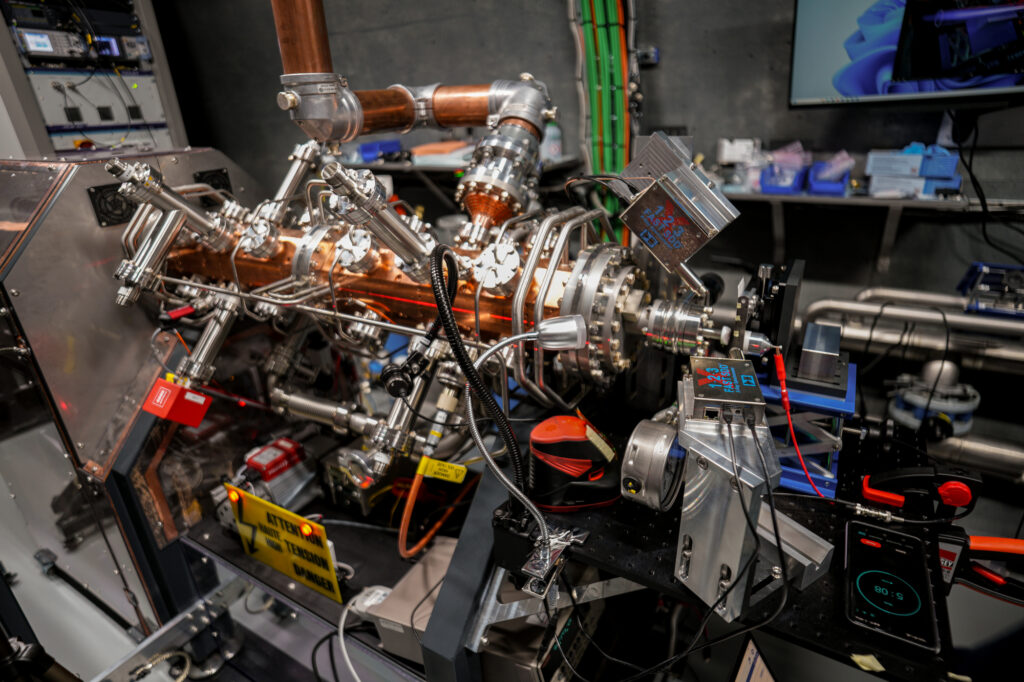
Graphic: ELISA RFQ accelerator at the CERN Science Gateway, Source: CERN Science Gateway – ELISA RFQ accelerator, © CERN