
The European project IFIGENEIA is developing technologies and expertise for accelerator-based applications in nuclear medicine.
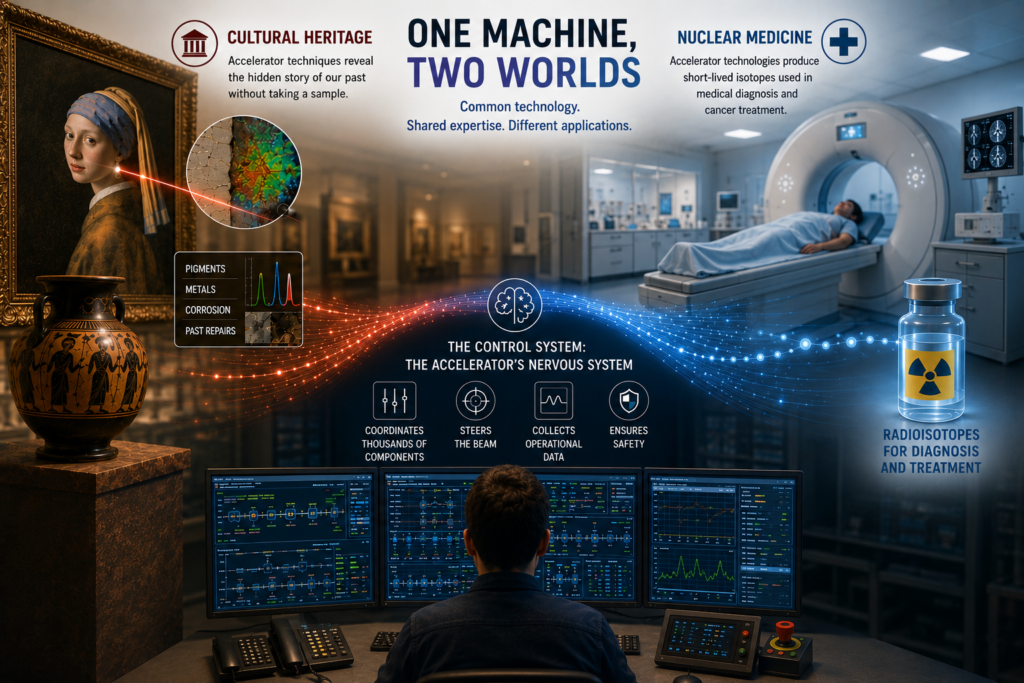
As part of the project’s knowledge-transfer and capacity-building activities, accelerator-based techniques are also being explored for cultural heritage applications. These techniques can reveal exactly what a museum object is made of – identifying pigments, metals, corrosion products and past repairs without the need to remove a sample. At the same time, accelerator technologies are used to produce short-lived radioactive isotopes, which hospitals rely on for cancer diagnosis and treatment.
While the final infrastructures are designed for different purposes, both fields benefit from common accelerator technologies and expertise.
What makes this possible is not just the accelerator itself, but the control system behind it.
A particle accelerator is a highly complex machine made up of thousands of components like magnets, vacuum pumps, power supplies, sensors and safety systems – all of which must work together with extraordinary precision. The control system acts as the accelerator’s nervous system, coordinating these elements, steering the beam, collecting operational data and ensuring the machine can respond safely if something goes wrong.
It is also what allows different accelerator systems to operate efficiently and reliably for their intended applications. Whether supporting cultural heritage studies or the production of medical isotopes, robust control-system design is essential for safe and effective operation.
As with most major accelerator facilities around the world, the system will be built on open-source control software developed collaboratively by an international community of laboratories and research institutions. This approach helps ensure long-term sustainability: no single company owns the technology, and the organisations that depend on it continue to maintain and improve it together.
The accelerator hardware is the most visible part of a facility, but what it can actually do depends on the control system. It is the layer that ties thousands of components together and enables accelerator facilities to reliably support applications ranging from heritage science to nuclear medicine.
Author: Andrej Debenjak, COSYLAB
Image: AI-generated