
News

News
IFIGENEIA Releases Its Third Newsletter
The IFIGENEIA project has published the third edition of its newsletter, reflecting on the progress achieved during the first project year and looking ahead to the next phase of scientific, technical and collaborative activities. This edition highlights IFIGENEIA’s...
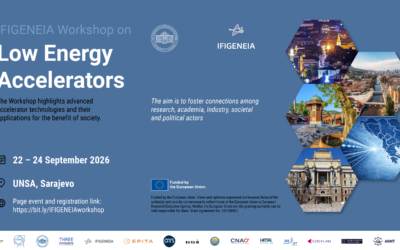
IFIGENEIA Workshop: Low Energy Accelerators
In the framework of the IFIGENEIA mentorship activities, an International Workshop will take place in Sarajevo, Bosnia and Herzegovina, hosted by UNSA, from 22 to 24 September 2026, on Particle Accelerators Applications for Society. Expert lectures will cover...
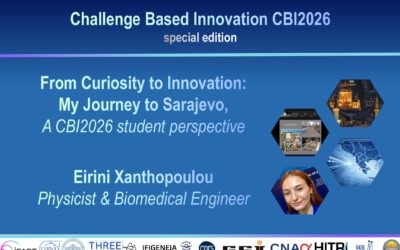
From Curiosity to Innovation: My Journey to Sarajevo
On 17 September 2026, the online lecture series of the Challenge Based Innovation CBI2026 special edition, focusing on Particle Accelerators’ Applications for Society (https://indico.cern.ch/event/1661135/page/42417-challenge-based-innovation), concluded with a...
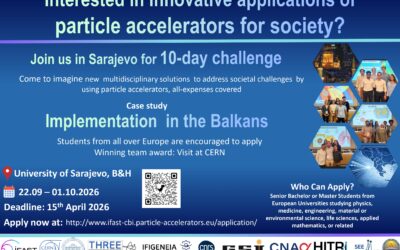
CBI2026: Students Explore Particle Accelerator Applications for Society
The Challenge Based Innovation 2026 programme began online on 1 September. Through introductory lectures, participating students are learning about particle accelerators and exploring how these technologies could benefit society. From online learning to Sarajevo The...

Lu-177 Therapies: Rising Future Demand
Demand for Lu-177-based cancer therapies is expected to grow significantly across Europe and the wider region by 2040, according to recent analytical work carried out within the IFIGENEIA project, covering Cyprus, Slovenia, Greece, Croatia and North Macedonia. The...

One Technology, Two Worlds: Art and Medicine
The European project IFIGENEIA is developing technologies and expertise for accelerator-based applications in nuclear medicine. As part of the project’s knowledge-transfer and capacity-building activities, accelerator-based techniques are also being explored for...
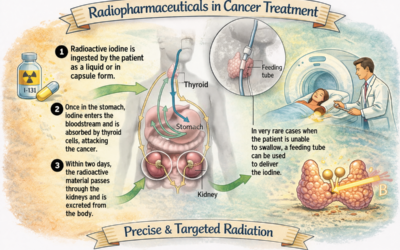
Did you know: Iodine-131: A small atom with a big history
The story of iodine-131 began in the late 1930s, when physicists at MIT - including Saul Hertz and Arthur Roberts - first proposed that radioactive iodine could be used to treat thyroid disease. Their insight was elegant: the thyroid gland naturally absorbs iodine...
Why IFIGENEIA Matters: YFOS
What does IFIGENEIA mean to YFOS? In this one-minute video, Theano Lampoudi shares what motivated YFOS to join the project and how IFIGENEIA supports the company's vision for innovation and technological advancement. Watch the video to hear their story.
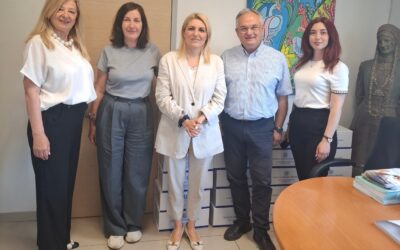
Medical Radioisotopes Innovation in Central Macedonia
Advancing innovation in nuclear medicine, strengthening research capacity, and fostering collaboration across the health ecosystem are among the key opportunities highlighted through ongoing efforts to develop radioisotope production capabilities in Central Macedonia....
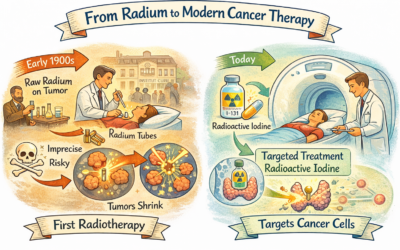
Did you know: From radium to modern cancer therapy
In the early 1900s, a cancer diagnosis often meant there was little hope. Surgery was risky, and many tumours could not be removed. Around this time, scientists like Marie Curie had discovered radium - a substance that emitted powerful, invisible radiation. Doctors...
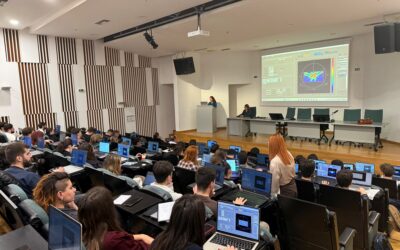
Particle Therapy Masterclass, Greece, March 2026
The Aristotle University of Thessaloniki hosted two Particle Therapy MasterClasses PTMC carried out under the scientific coordination of Dr. Yiota Foka, physicist and researcher at GSI and CERN. It aimed to introduce students to cutting-edge developments at the...
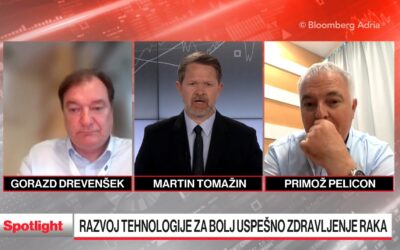
IFIGENEIA on Bloomberg Adria: The Importance of Radioisotopes
As part of the 2nd Annual Meeting of the IFIGENEIA Project held in Ljubljana in May 2026, Dr Gorazd Drevenšek from the University of Ljubljana Faculty of Medicine and Prof. Dr Primož Pelicon from the Jožef Stefan Institute spoke to Bloomberg Adria TV about the growing...