Radioactive iodine (I-131 and I-123) had already shown what nuclear medicine could do. By following a substance naturally taken up by the thyroid, physicians could not only treat thyroid disease, but also observe the gland at work. It demonstrated the broader potential of nuclear medicine: not simply to visualize organs, but to reveal how they functioned. But iodine’s usefulness was tied to one organ (see Did you know #3 and Did you know #4).
In the 1970s, nuclear medicine began changing the way doctors looked inside the rest of the body. Until then, most imaging techniques outside thyroid studies showed only anatomy, what organs looked like. Scientists now wanted to extend what radioactive iodine had made possible for the thyroid to the rest of the body: a way to see how organs functioned. Extending functional imaging further meant finding radionuclides that could be paired with the right molecule for each organ: in the heart, the brain, the bones, and beyond.
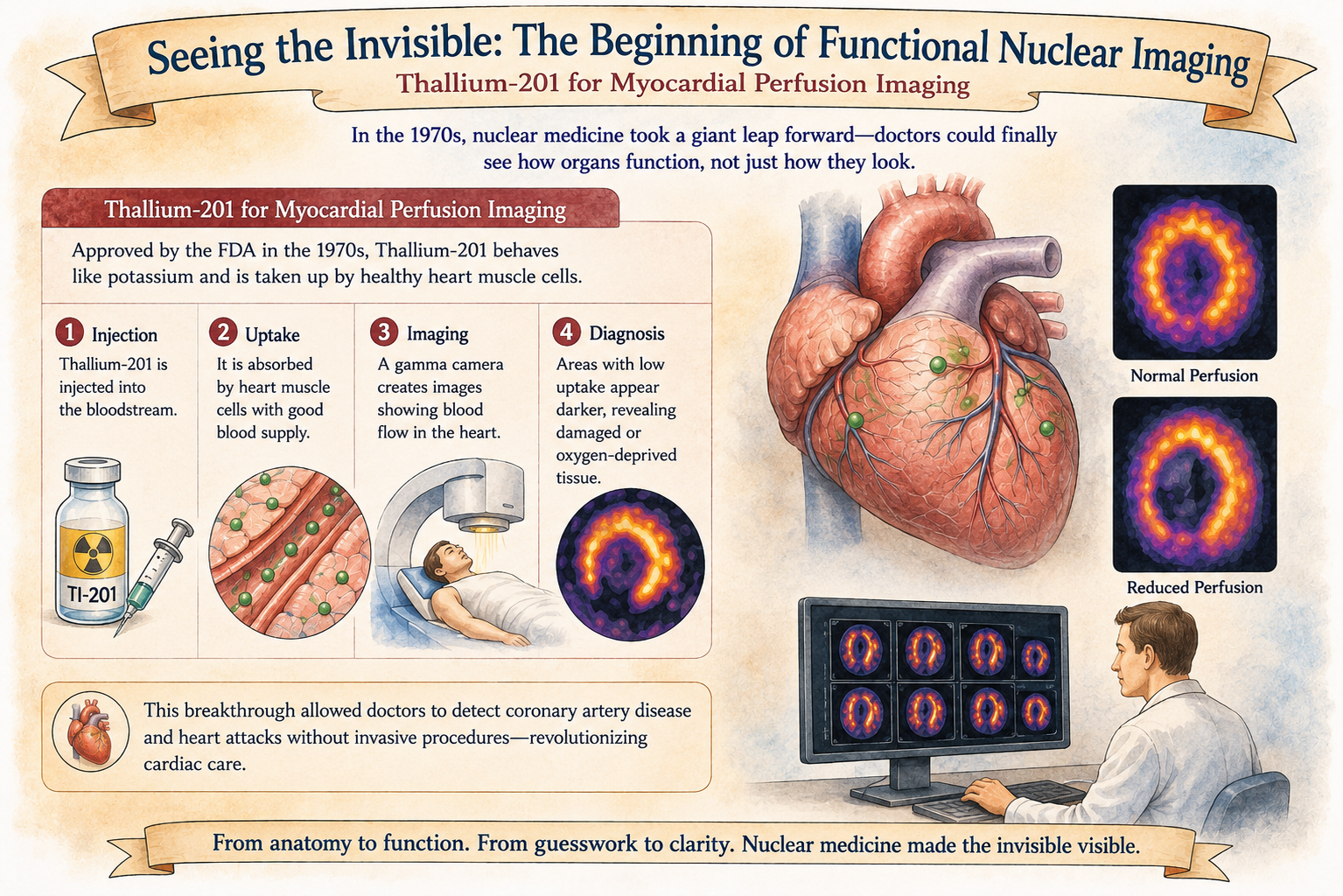
A major turning point in this story came in the mid-1970s, when Thallium-201 was introduced for myocardial perfusion imaging. Doctors discovered that thallium behaves similarly to potassium and is naturally taken up by healthy heart muscle cells. After injection, a gamma camera could follow its distribution through the heart, and areas of reduced uptake revealed damaged or oxygen-deprived tissue. For the first time, physicians could assess blood flow inside a beating heart without invasive catheterization.
Around the same time, another radioactive element was quietly becoming the true backbone of nuclear medicine: Technetium-99m (Tc-99m), which could be linked to many different molecules, each designed to carry Tc-99m to a particular organ or biological process. With Tc-99m, scientists had gained something far more versatile: a radioactive label that could be adapted to reveal different functions throughout the body. And that versatility was about to make Tc-99m the true workhorse of nuclear medicine, a story that deserves its own chapter.
Authors: Marko Krošelj, Martina Perše
Pictures: AI-created