
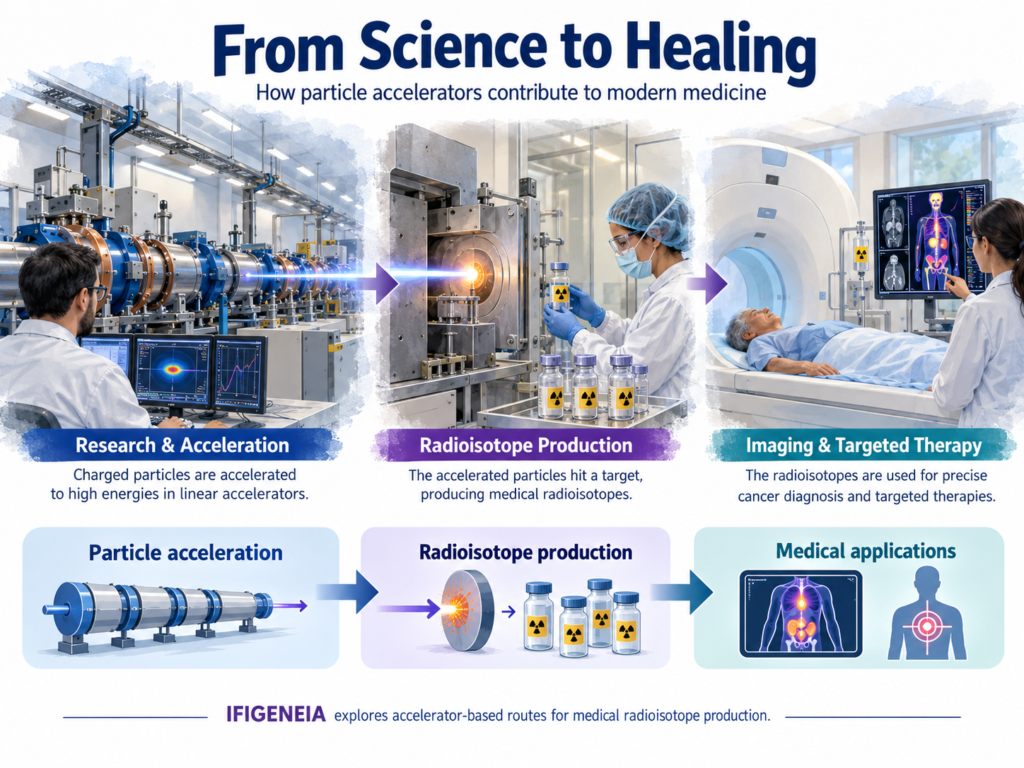
Particle accelerators are often associated with scientific discoveries and large research laboratories. But did you know that they also play an important role in modern medicine?
The story began more than 100 years ago. In 1895, the German physicist Wilhelm Röntgen discovered X-rays, allowing doctors to see inside the human body without surgery. This breakthrough transformed medical diagnosis and opened the door to new uses of radiation in healthcare.
A few decades later, scientists developed the first particle accelerators, machines that use electric fields to speed up charged particles to high energies. While these machines were initially built for research, their potential for medical applications soon became clear.
One of the most important developments came in the 1950s with the introduction of medical linear accelerators, or linacs. These machines accelerate electrons to produce high-energy X-rays that can destroy cancer cells while limiting damage to surrounding healthy tissue.
Today, accelerators are used in hospitals around the world, mainly for cancer radiotherapy. But they also have another important application: the production of medical radioisotopes. By accelerating particles such as protons, deuterons or alpha and directing them onto a suitable target, scientists can produce radioisotopes used in nuclear medicine, both for diagnosing diseases and for treating certain types of cancer.
This is also the focus of IFIGENEIA. The project is working on the design of a compact linear ion accelerator for medical radioisotope production. Alongside the accelerator itself, researchers are studying the targets, irradiation conditions and production processes needed to obtain specific radioisotopes. The longer-term goal is to develop alternative production methods that could help make medical radioisotopes more widely available and reduce dependence on a limited number of production facilities.
Picture: AI-generated illustration.
Author: Fanouria Antoniou, AUTH