The story of iodine-131 began in the late 1930s, when physicists at MIT – including Saul Hertz and Arthur Roberts – first proposed that radioactive iodine could be used to treat thyroid disease. Their insight was elegant: the thyroid gland naturally absorbs iodine from the bloodstream to produce hormones. What if the iodine it absorbed was radioactive?
The idea was tested carefully. By 1941, the first patients with hyperthyroidism were treated with iodine-131, and the results were remarkable. For the first time, a radioactive substance was being used not just to destroy tumours blindly, but to seek out a specific tissue and destroy it from within – a principle that would go on to define the entire field of targeted radionuclide therapy.
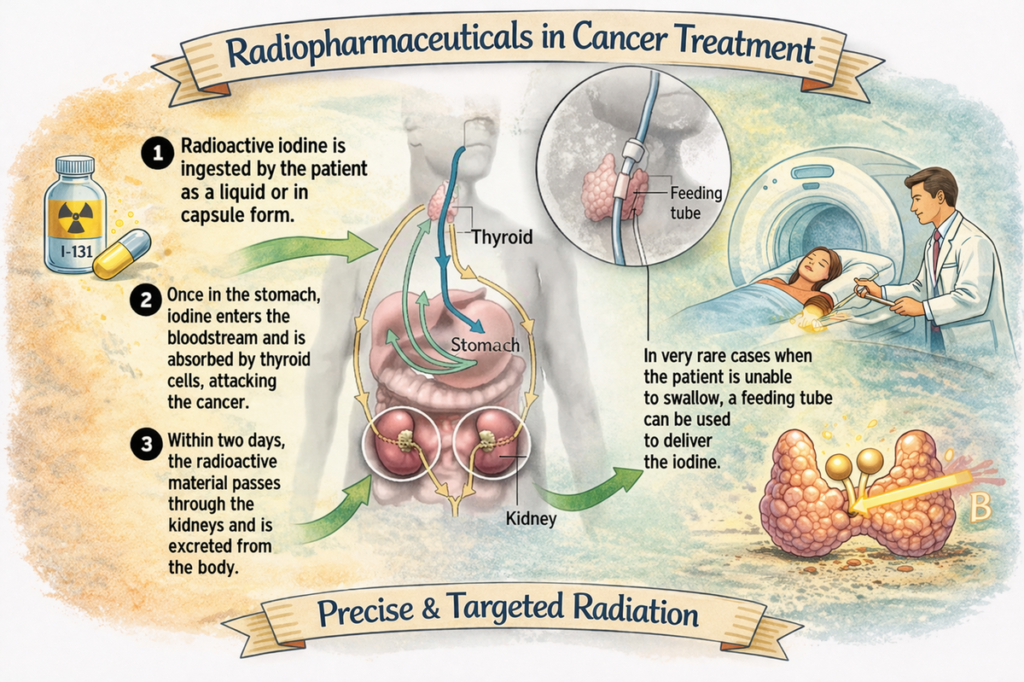
Iodine-131 works by emitting beta radiation, which travels only a short distance in tissue, damaging the cells that have absorbed it while largely sparing the surrounding healthy tissue. When a patient with thyroid cancer swallows a capsule or drink containing iodine-131, the radioactive iodine travels through the bloodstream and is taken up almost exclusively by thyroid cells – including any cancerous cells that may have spread elsewhere in the body. Those cells are then destroyed from the inside.
What began as a bold hypothesis in a university laboratory became one of the most widely used and successful treatments in nuclear medicine. In fact, iodine-131 is widely regarded as the first true radiopharmaceutical – the moment when a radioactive substance was intentionally designed to seek out and treat a specific tissue, laying the foundation for everything that followed. It remains a standard of care for thyroid cancer and hyperthyroidism to this day – a testament to how a deep understanding of biology and physics together can produce treatments that are both powerful and precise.
Authors: Marko Krošelj, Martina Perše
Pictures: AI created