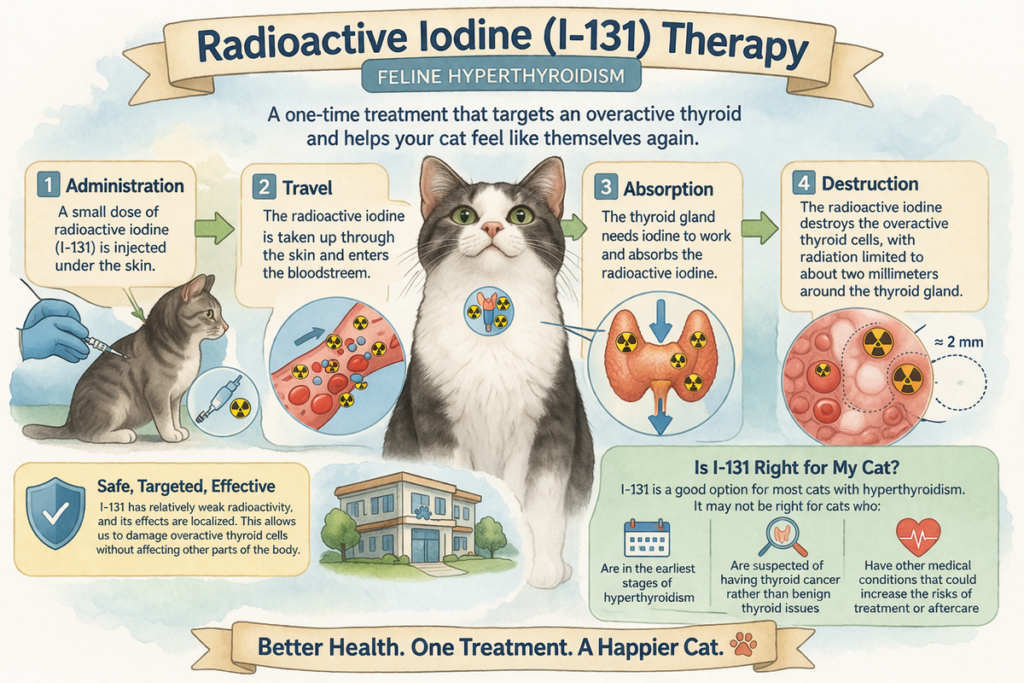
Did you know that targeted radionuclide therapy is used not only to treat people but also animals?
When we think about radiation therapy, we usually imagine hospitals treating cancer patients. But the same science is also helping veterinarians treat diseases in pets.
As cats get older, some of them develop a condition called hyperthyroidism. This means their thyroid gland becomes overactive and produces too many hormones. Cats with this condition may lose weight, become restless, and feel unwell.
For a long time, treating this required daily medication – something that can be difficult for both cats and their owners. But in the 1980s, veterinarians began applying the same principle that had already transformed human medicine: targeted radionuclide therapy using iodine-131. Just as in humans, the thyroid cells of cats naturally absorb iodine from the bloodstream. When iodine-131 is administered, it travels directly to those overactive thyroid cells and destroys them from within – while nearby tissues remain largely unaffected.
Because the treatment involves radioactivity, it must be carried out in specialised veterinary centres with strict safety protocols. But the outcomes speak for themselves: a single treatment is often curative, with no need for lifelong medication.
From human oncology wards to veterinary clinics, targeted radionuclide therapy is a powerful example of how a deep understanding of biology and physics can improve health – not just for people, but for all living beings.
Authors: Marko Krošelj, Martina Perše
Pictures: AI created