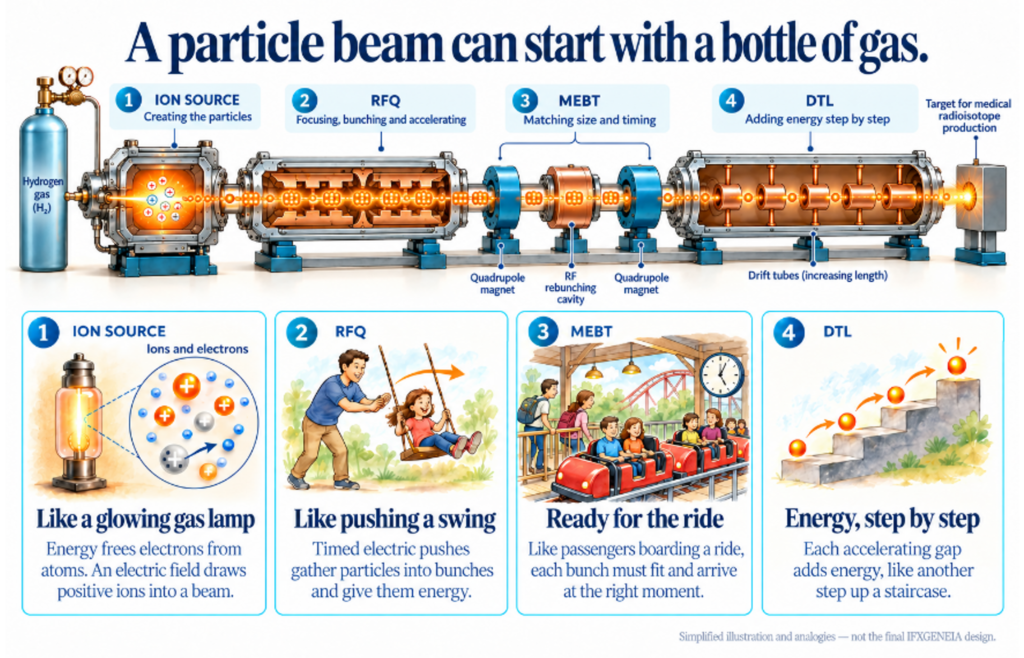
Before a particle beam is ready to produce medical radioisotopes, it must be generated, accelerated and directed towards a target. Its journey can begin with something surprisingly simple: a small amount of gas.
Starting from a bottle of gas
Inside a device called an ion source, energy is supplied to a gas, freeing electrons from its atoms or molecules. This produces a plasma containing positive ions and free electrons, together with particles that remain neutral – much like the ionized gas inside a glowing gas-discharge lamp.
An electric field draws positive ions out of the source and forms them into a beam. The gas and source are chosen according to the particles needed: hydrogen can provide protons, deuterium can provide deuterons, and helium can provide helium ions.
The particles leave the source with an initial energy, ready for the next stage of acceleration. Throughout their journey, they travel through a vacuum to minimise collisions with gas molecules.
Giving the right push at the right time
Think of pushing a swing. A push at the right moment adds energy. At the wrong moment, it can slow the swing down.
A radiofrequency linear accelerator works on a similar principle, with electric fields instead of a hand. These fields alternate rapidly, giving the particles precisely timed pushes as they travel through the accelerator.
In the Radio Frequency Quadrupole, or RFQ, four specially shaped electrodes surround the beam. Their electric fields focus the particles, group them into bunches, and accelerate them. This way, the continuous incoming stream is transformed into a sequence of particle bunches travelling in tune with the accelerating fields.
Getting ready for the next ride
Imagine passengers boarding a roller coaster: each group must fit into its carriage and board at the right moment. A particle beam needs similar preparation before entering the next accelerator section.
The RFQ has already gathered the particles into bunches. In the next stage, the Medium Energy Beam Transport, or MEBT section, fine-tunes the beam before enters the next stage. Magnetic elements adjust the beam’s width, height and how it spreads or converges. Radiofrequency cavities adjust the bunches’ length and timing, helping them to arrive in step with the next section of accelerating fields.
These adjustments help the next accelerator section to accept and accelerate the beam efficiently.
Adding energy step by step
The beam then enters the Drift Tube Linac, or DTL, where a series of accelerating gaps gives more energy to the particles – like climbing an energy staircase.
The particles travel through a series of hollow metal tubes separated by small gaps. Each time they cross a gap the electric field gives them a boost of energy. Then, they drift through a tube. The tubes shield them during the part of the radiofrequency cycle when the electric field would otherwise slow them down.
The distances between gaps, that is the length of the tubes, are carefully chosen so that the particles reach the next gap at the right moment to receive another boost. Gap by gap, the beam climbs the energy staircase, reaching the energy needed for its intended application.
These principles underpin the ion accelerator technologies being studied within IFIGENEIA. From the source to the final accelerating stage, each section helps prepare the beam for its destination: the carefully selected target, where nuclear reactions can produce medical radioisotopes.
Picture: AI-generated illustration.
Authors: Fanouria Antoniou, Georgios Dianos, AUTH