Advancing innovation in nuclear medicine, strengthening research capacity, and fostering collaboration across the health ecosystem are among the key opportunities highlighted through ongoing efforts to develop radioisotope production capabilities in Central Macedonia.
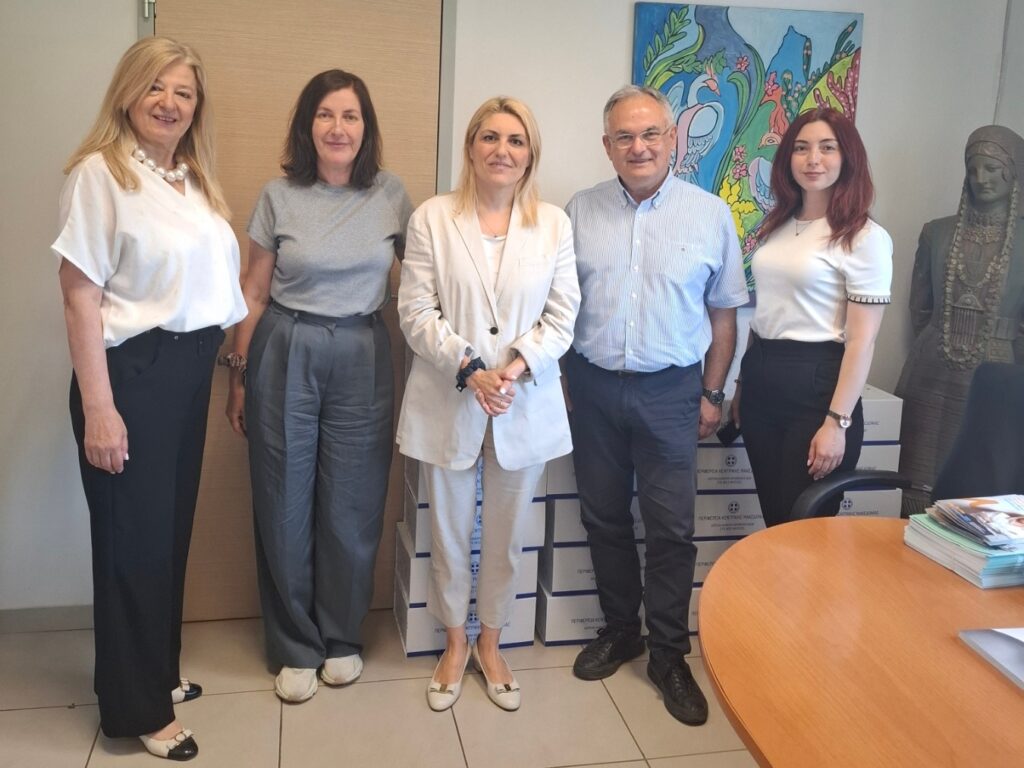
A meeting at the Region of Central Macedonia (RCM) brought together the Deputy Regional Governor for Health and Social Solidarity of the RCM, Ms. Melina – Maria Dermentzopoulou, the Head of the General Directorate of Public Health and Social Welfare of the RCM, Ms. Kalliopi Balla, Professor at Aristotle University of Thessaloniki and Coordinator of the European project IFIGENEIA, Dr. Dimitrios Sampsonidis, and executives of the Department of EU Programmes & Synergies of the Directorate of Innovation & Entrepreneurship of the RCM.
During the meeting, the objectives and progress of the IFIGENEIA project (Innovative Facility for Isotope GENeration with Efficient Ion Accelerator), which is funded by the Horizon Europe programme and is coordinated by Aristotle University of Thessaloniki, were presented. The project aims to develop linear accelerator technologies for the production of radioisotopes for medical applications, strengthening cooperation between universities, research centres, hospitals, and businesses at the European level.
The discussion focused on the importance of radioisotopes for modern healthcare, as they constitute a critical tool for the diagnosis and treatment of oncological and other serious diseases. At the same time, the need to develop an advanced linear accelerator infrastructure for the production of radioisotopes in Thessaloniki was analysed, highlighting the potential and capacity of the region to significantly enhance research and clinical activity and to create new opportunities for collaboration between academic, research, and healthcare institutions.
Emphasis was placed on the dynamics created by the IFIGENEIA project for the Region of Central Macedonia, which has a strong ecosystem in the fields of research, health, and innovation, with the presence of important academic and research institutions, hospitals, and high-tech companies. In this context, the prospect of developing a regional innovation hub in the fields of nuclear medicine, biomedical technologies, and health innovation was highlighted, positioning Thessaloniki as its focal point, contributing to the attraction of new high value-added research, technological, and business activities, the creation of specialized jobs for youths, and the strengthening of the international visibility of the Region through collaborations with international organizations such as CERN and DKFZ.
The IFIGENEIA project aspires to contribute to the creation of a European hub for nuclear medicine and accelerator technologies, with significant benefits for health, research, and innovation, strengthening the position of the Region of Central Macedonia on the European map of research, innovation, and health technologies.